Indonesia’s Palm Kernel Expeller: Fueling the Future of Global Animal Feed
How Indonesia became the world’s most reliable source of PKE and why international buyers trust its supply chain.
In an era where global food systems face mounting pressures from population growth, climate volatility, and sustainability mandates, palm kernel expeller (PKE) has emerged as a cornerstone of efficient animal nutrition. Derived as a byproduct from palm kernel oil extraction, PKE offers a protein-rich (typically 15-18%), cost-effective feed ingredient that supports livestock, poultry, and aquaculture sectors worldwide. As the global animal feed market surges toward USD 681.8 billion by 2033, driven by rising meat demand and a projected 30% world population increase by 2050, Indonesia stands out as the preeminent supplier of PKE. This Southeast Asian powerhouse not only dominates production but also exemplifies how strategic resource management can transform agricultural byproducts into a reliable export engine. For corporate buyers, institutional investors, and policymakers navigating supply chain disruptions, understanding Indonesia’s PKE ascendancy provides actionable pathways to secure resilient, sustainable sourcing strategies.
Indonesia’s Path to PKE Supremacy: From Byproduct to Global Powerhouse
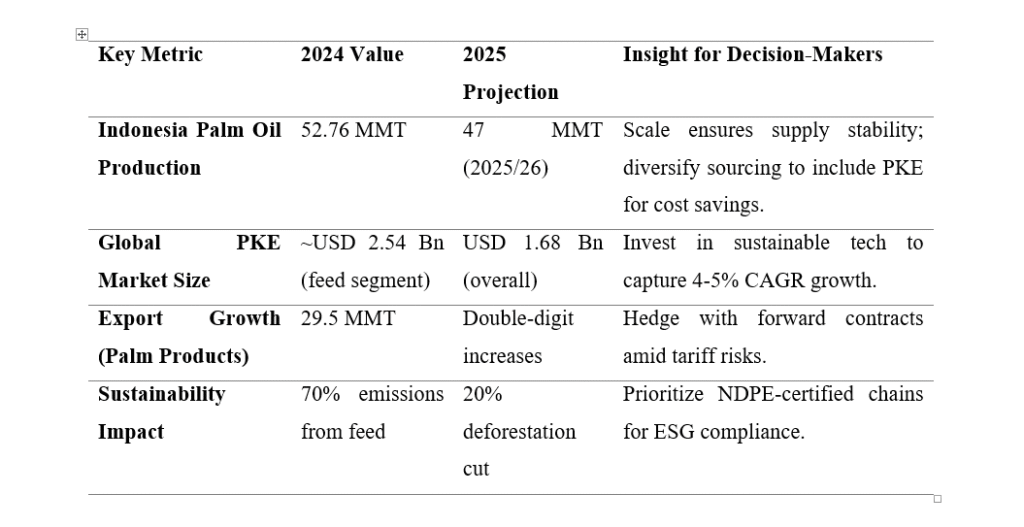
Indonesia’s journey to becoming the world’s leading PKE producer is rooted in its unparalleled palm oil industry, which accounts for over half of global supply. In 2024, the country produced approximately 52.76 million metric tons (MMT) of palm oil, including 4.60 MMT of palm kernel oil—a key precursor to PKE. Projections for 2025/26 forecast total palm oil output rising to 47 MMT, with palm kernel oil expected to climb from 5.33 MMT in 2024 to 5.46 MMT in 2025, underscoring sustained yield improvements despite environmental challenges.
This production boom translates directly into PKE availability, as the expeller is the residual meal left after oil extraction. Export data highlights Indonesia’s market command: In the first half of 2025, palm oil exports (including derivatives like PKE) reached USD 17.277 billion, a 34.64% year-on-year increase, with volumes hitting 11 MMT. Specific to PKE, global trade records show Indonesia facilitating over 4,276 export shipments in the 12 months ending August 2024, positioning it as a primary source for importers in Europe, Asia, and beyond.
What propelled this dominance? A confluence of factors: Indonesia’s tropical climate enables year-round cultivation, supported by expansive plantations and government policies promoting agribusiness. The sector contributes 12.61% to national GDP and employs 28% of the workforce, aligning with national goals to reduce import dependency in animal feeds. For strategic decision-makers, this means Indonesia offers scalable volumes—essential for hedging against global supply shocks, such as those from geopolitical tensions or weather events in alternative protein sources like soybean meal.
PKE’s Pivotal Role in Sustainable Animal Feed Innovation
Globally, PKE is prized for its nutritional profile: 15% protein, 6% lipids, and mineral content surpassing traditional pasture feeds, making it ideal for ruminants at intakes up to 6kg per day for dairy cows. In livestock diets, it boosts efficiency, with studies showing improvements in feed conversion ratios by up to 5% when integrated alongside byproducts like distillers dried grains with solubles (DDGS). As a sustainable alternative to soybean or rapeseed meals, PKE repurposes palm industry waste, reducing environmental footprints in a sector where feed production accounts for 70% of animal products’ carbon emissions.
Market intelligence from 2024-2025 reveals explosive growth: The global PKE market, valued at USD 1.22 billion in 2021, is projected to reach USD 1.68 billion by 2025, fueled by demand for eco-friendly, high-protein feeds. In Indonesia’s domestic market, animal feed is valued at USD 8.7 billion in 2024, expanding at a 4.15% CAGR to USD 12.5 billion by 2033, with PKE playing a central role in poultry (40% market share) and aquaculture. For investors, this signals opportunities in vertically integrated supply chains, where PKE’s low-cost profile (competitive pricing due to Indonesia’s scale) enhances profitability amid rising feed additive markets projected at USD 612.3 million by 2030.
Sustainability is a key differentiator. Initiatives like combining PKE with oil palm fronds and decanter solids demonstrate reduced environmental impacts, promoting circular economies. Global buyers increasingly favor PKE for its alignment with regenerative practices, addressing controversies around palm-derived deforestation by emphasizing traceable, zero-waste models.
Building Trust: The Resilience of Indonesia’s PKE Supply Chain
International buyers trust Indonesia’s PKE for its predictability and ethical advancements. Top producers ensure international-grade quality through rigorous lab testing and batch consistency, with suppliers like those in Indonesia offering traceable origins that meet global standards. Competitive pricing—bolstered by low labor costs and high-scale production—makes it an attractive option, while integrated logistics networks guarantee timely deliveries.
Traceability and sustainability seal the deal. Companies like ADM collaborate with Indonesian suppliers to achieve third-party verified deforestation-free sourcing, adhering to No Deforestation, No Peatland, No Exploitation (NDPE) policies. This has led to a 20% reduction in deforestation within palm supply chains, aligning with UN goals and appealing to ESG-focused investors. For corporate leaders, this mitigates risks from regulatory pressures, such as EU deforestation rules, while fostering long-term contracts in a market where Indonesia’s exports to the US averaged 2.25 MMT annually in 2024.
Navigating Challenges: Actionable Strategies for Stakeholders
Despite strengths, challenges persist: Deforestation links have drawn scrutiny, but Indonesia’s progress—via national efforts and private governance—offers a model for improvement. Export levies and biodiesel mandates (e.g., B40) may temper outflows, with 2024/25 palm oil exports revised down to 22.8 MMT. Yet, opportunities abound: Investors can capitalize on organic PKE segments, while buyers should prioritize certified suppliers for risk mitigation.
Forging Ahead: Indonesia’s PKE as a Strategic Imperative
As global animal feed demands escalate, Indonesia’s PKE ecosystem—blending production prowess, nutritional efficacy, and sustainability reforms—positions it as an indispensable ally for food security. For corporate executives, this translates to actionable imperatives: Audit supply chains for Indonesian PKE integration to optimize costs and emissions; for investors, target funds in palm byproducts amid projected booms; and for policymakers, foster trade pacts that amplify ethical sourcing. By leveraging Indonesia’s reliable framework, stakeholders can not only fuel today’s livestock needs but also sustain tomorrow’s resilient agrifood systems.